Table of Contents
- 1. Introduction
- 2. What Is a CIBIL Score?
- 3. Why Your CIBIL Score Matters in Chikka Banavara
- 4. 15 Common Reasons for a Low CIBIL Score
- 5. How to Check Your CIBIL Report
- 6. Common CIBIL Report Errors
- 7. How to Correct CIBIL Report Errors
- 8. CIBIL Score Repair vs Credit Report Correction
- 9. How to Improve a Low CIBIL Score
- 10. What to Do If Your Loan Was Rejected
- 11. Personal Loan and CIBIL Score
- 12. Home Loan and CIBIL Score
- 13. Business Loan and CIBIL Score
- 14. Credit Card and CIBIL Score
- 15. How Long Does CIBIL Score Repair Take?
- 16. NIDEE Credit Report Analysis Service
- 17. NIDEE CIBIL Score Repair Support
- 18. NIDEE Loan Eligibility Enhancement
- 19. NIDEE's 4-Step Process
- 20. Why Choose Professional Credit Report Analysis?
- 21. Looking for CIBIL Score Repair Near Chikka Banavara?
- 22. 30-Day Credit Profile Action Plan
- 23. Common Mistakes to Avoid
- 24. Real-Life User Scenarios
- 25. Frequently Asked Questions
- 26. Before Applying for Your Next Loan
Quick Answer: What Is CIBIL Score Repair?
CIBIL score repair generally involves reviewing your credit report, identifying inaccurate or outdated information, addressing genuine reporting errors through appropriate dispute processes, managing outstanding obligations responsibly, and developing healthier credit behaviour. Professional credit report analysis can help identify the factors affecting your profile.
1. Introduction
Imagine this: You live in Chikka Banavara, Bangalore, and you have been planning to buy a home. You have saved for the down payment, found the perfect property, and are ready to apply for a home loan. But the bank says "No."
Your CIBIL score is low. And you have no idea why.
This happens to thousands of people across Chikka Banavara and North Bengaluru every single day. Whether it is a personal loan, home loan, business loan, or credit card-a low CIBIL score can stop your financial plans in their tracks.
Many borrowers know their CIBIL score is low but do not know:
- Why it dropped
- Which account caused the problem
- Whether the report contains an error
- Whether an old loan is still affecting them
- Whether a loan settlement is appearing
- Why a lender rejected their application
- What they should do before applying again
That is where professional credit report analysis and CIBIL score repair support can be useful. In this guide, we will explain everything you need to know about improving your credit profile-with a focus on Chikka Banavara, Bangalore.
2. What Is a CIBIL Score?
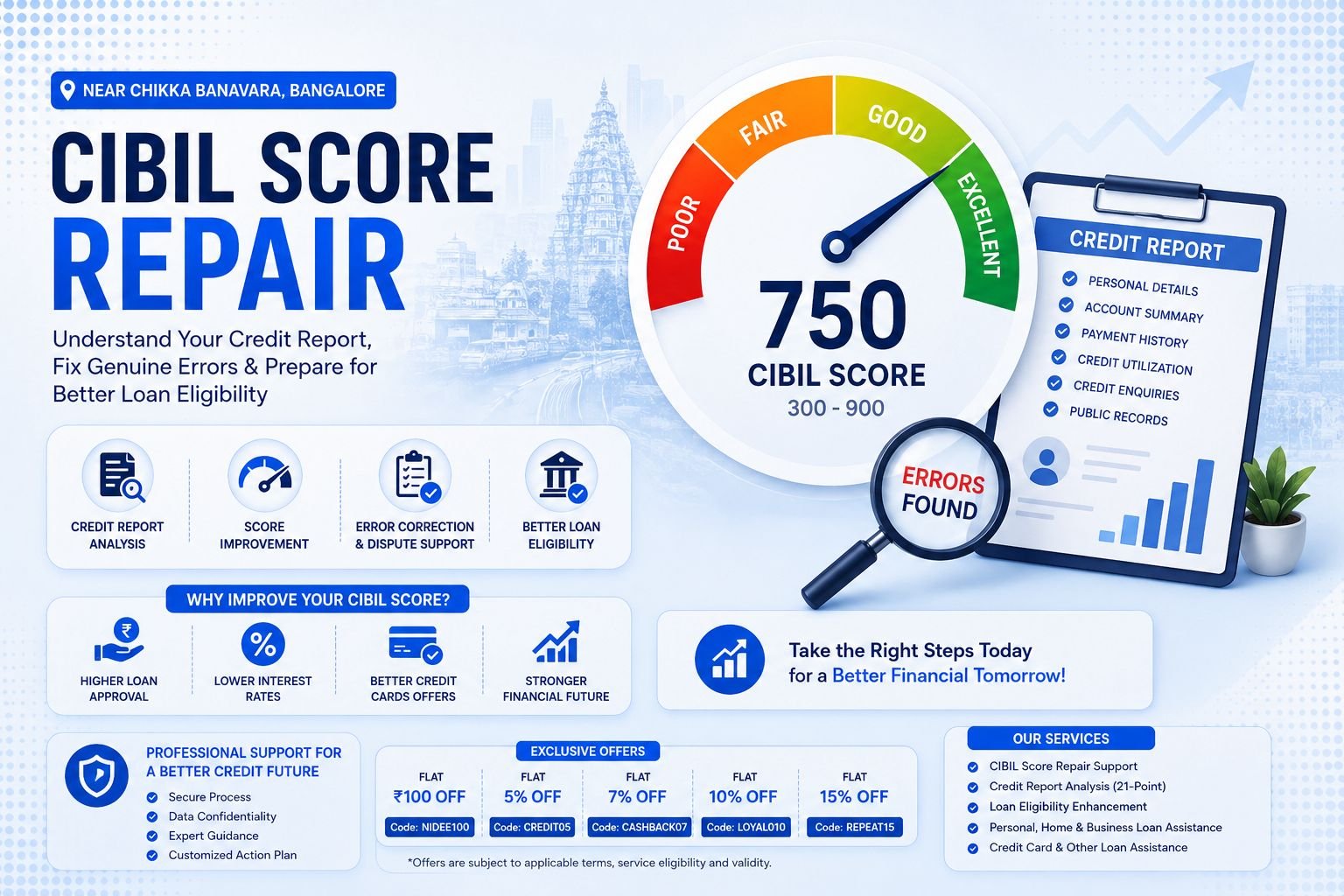
CIBIL Score is a three-digit number that represents your creditworthiness. It ranges from 300 to 900. A higher score means you are seen as a lower risk by lenders.
Purpose: The score helps lenders quickly assess your likelihood of repaying a loan.
Who uses it: Banks, NBFCs, credit card companies, and even some landlords and employers.
| Score Range | General Interpretation | What You Should Consider |
|---|---|---|
| 800 – 900 | Excellent | Very high likelihood of loan approval. Best interest rates. |
| 750 – 799 | Good | Most loans get approved. Competitive interest rates. |
| 650 – 749 | Average | May get loans with higher interest or stricter terms. |
| 550 – 649 | Needs Improvement | Loan approval is difficult. Need to take corrective steps. |
| 300 – 549 | Poor | Very low chance of loan approval. Urgent credit repair needed. |
Important: Lenders use their own eligibility criteria. A particular score does not guarantee approval. Lenders also consider income, employment, existing EMIs, debt obligations, and other factors.
3. Why Your CIBIL Score Matters in Chikka Banavara
If you live in or near Chikka Banavara, Bangalore, your CIBIL score can affect several aspects of your financial life:
- Personal loan applications: Whether you can get a loan for a wedding, travel, or emergency.
- Home purchase financing: Buying a home in North Bengaluru requires a good credit profile.
- Business funding: Local business owners need loans for working capital or expansion.
- Vehicle financing: Car and two-wheeler loans are harder to get with a low score.
- Credit cards: A low score can mean rejection or a very low credit limit.
- Education loans: Students from Chikka Banavara may need loans for higher education.
- Mortgage or loan against property: Property owners may need to leverage their assets.
Lenders in Bangalore may review your score along with:
- Income and employment stability
- Business performance (for self-employed individuals)
- Existing EMIs and debt obligations
- Bank statements and documentation
- Collateral (if applicable)
- Lender-specific policies
4. 15 Common Reasons for a Low CIBIL Score
Here are the most common reasons why your CIBIL score may be low:
1. Missed EMI Payments
Problem: You delayed or skipped one or more EMI payments.
Why It Matters: Payment history is the most important factor in your credit score.
What to Check: Look for "1" (30 days late), "2" (60 days late), or "3" (90+ days late) in your report.
Practical Next Step: Set up auto-debits or reminders. Pay the missed amount as soon as possible.
2. Late Credit Card Payments
Problem: You paid your credit card bill after the due date.
Why It Matters: Credit card companies report your payment behaviour every month.
What to Check: Review your payment history for any late payments.
Practical Next Step: Always pay your credit card bill in full and on time.
3. High Credit Card Utilization
Problem: You are using more than 30% of your total available credit limit.
Why It Matters: High utilization indicates that you are heavily dependent on credit.
What to Check: Compare your outstanding balance with your credit limit.
Practical Next Step: Try to keep your utilization below 30%.
4. Too Many Loan Applications
Problem: You have applied for multiple loans in a short period.
Why It Matters: Each application generates a hard enquiry on your credit report.
What to Check: Count the number of enquiries in the last 6 months.
Practical Next Step: Apply only when you genuinely need a loan.
5. Too Many Hard Enquiries
Problem: Lenders have checked your credit report multiple times.
Why It Matters: Multiple hard enquiries signal that you are desperate for credit.
What to Check: Review the enquiry section of your report.
Practical Next Step: Avoid applying for multiple loans at the same time.
6. Loan Settlement
Problem: You have settled a loan by paying a reduced amount.
Why It Matters: A settled account is seen as negative by lenders.
What to Check: Look for accounts marked as "Settled."
Practical Next Step: Avoid settlements if possible. Build positive history on other accounts.
7. Written-Off Accounts
Problem: The lender has written off your loan as a loss.
Why It Matters: A written-off account is a severe negative mark.
What to Check: Look for accounts marked as "Written-Off."
Practical Next Step: Contact the lender to settle the written-off account.
8. Old Outstanding Dues
Problem: You have forgotten about old loans or credit card dues.
Why It Matters: Old dues can stay on your report for up to 7 years.
What to Check: Review your report for any old outstanding amounts.
Practical Next Step: Contact the lender to clear the dues.
9. Incorrect Repayment History
Problem: Your report shows late payments when you paid on time.
Why It Matters: Incorrect late payments can significantly reduce your score.
What to Check: Compare your payment history with your records.
Practical Next Step: Dispute the error with supporting documents.
10. Unknown Loan Accounts
Problem: A loan you never took appears on your report.
Why It Matters: It increases your debt burden on paper.
What to Check: Look for accounts from lenders you do not recognize.
Practical Next Step: Dispute the account and file a complaint.
11. Duplicate Accounts
Problem: The same loan appears twice on your report.
Why It Matters: Doubles your outstanding debt on paper.
What to Check: Look for accounts with the same lender and amount.
Practical Next Step: Dispute the duplicate account.
12. Closed Loans Showing Active
Problem: A loan you have closed is still showing as active.
Why It Matters: It increases your outstanding debt on paper.
What to Check: Look for loans you have closed but still show as "Active."
Practical Next Step: Dispute the error with your loan closure letter.
13. Incorrect Outstanding Balance
Problem: The balance shown is wrong (higher or lower than actual).
Why It Matters: Affects your debt-to-income ratio and score.
What to Check: Compare with your bank statement or loan statement.
Practical Next Step: Dispute the error with your account statement.
14. Short Credit History
Problem: You are a new borrower with limited repayment history.
Why It Matters: Credit bureaus need sufficient data to calculate your score.
What to Check: Look at the age of your oldest account.
Practical Next Step: Use a credit card responsibly and pay your bills on time.
15. Excessive Unsecured Borrowing
Problem: A large portion of your debt is from unsecured sources.
Why It Matters: Excessive unsecured borrowing is considered riskier.
What to Check: Review your personal loans and credit card balances.
Practical Next Step: Reduce reliance on unsecured debt.
5. How to Check Your CIBIL Report
Here is a step-by-step guide to check your CIBIL report:
- Obtain your report: You can get a free report once a year from CIBIL, Experian, Equifax, or CRIF.
- Verify personal details: Check your name, PAN, date of birth, and address.
- Check all accounts: Go through every loan and credit card account listed.
- Review payment history: Look for any "1" (30 days late), "2" (60 days late), or "3" (90+ days late).
- Compare balances: Check if the outstanding amounts match your records.
- Check enquiry section: Count the number of hard enquiries in the last 6–12 months.
- Verify account ownership: Make sure all accounts belong to you.
- Look for duplicates: Check if any account appears twice.
- Note discrepancies: Write down all errors you find.
- Prepare supporting documents: Gather evidence for each error.
Credit Report Self-Audit Checklist
- Your name is spelled correctly.
- Your PAN is correct.
- Your date of birth is accurate.
- All loan accounts belong to you.
- All credit cards belong to you.
- Closed accounts are marked as "Closed."
- Outstanding balances match your records.
- Payment history matches your records.
- No duplicate accounts exist.
- No unknown enquiries exist.
6. Common CIBIL Report Errors
- Wrong personal information: Incorrect name, PAN, date of birth, or address.
- Incorrect PAN information: Your PAN is linked to someone else's account.
- Unknown loan account: A loan you never took appears on your report.
- Wrong loan amount: The loan amount shown is incorrect.
- Wrong outstanding balance: The balance shown is wrong (higher or lower than actual).
- Incorrect late payment: A payment made on time is marked as late.
- Duplicate account: The same loan appears twice on your report.
- Closed loan appearing active: A loan you have closed is still showing as active.
- Incorrect account status: Account is marked as "Settled" but it was "Closed" or vice versa.
- Incorrect enquiry: An enquiry that you did not authorize appears on your report.
7. How to Correct CIBIL Report Errors
Step 1: Identify the inaccurate information.
Note down the specific error and the account it belongs to.
Step 2: Collect supporting documents.
Gather evidence that proves the error (e.g., loan closure letter, bank statement, payment receipts).
Step 3: Record account/reference details.
Note the account number, lender name, and the exact error.
Step 4: Submit a legitimate dispute through the appropriate process.
File a dispute online with the credit bureau or through their offline process.
Step 5: Track the reference or acknowledgement.
You will get a reference number. Use it to track the status.
Step 6: Follow up where appropriate.
Respond to any requests for more information.
Step 7: Review the updated report.
Check your report after the investigation to see if the error has been corrected.
8. CIBIL Score Repair vs Credit Report Correction
| Credit Report Correction | Credit Profile Improvement |
|---|---|
| Fix inaccurate information | Build better repayment behaviour |
| Dispute genuine errors | Reduce excessive utilization |
| Correct wrong balances | Avoid unnecessary enquiries |
| Correct account status | Maintain timely payments |
Both approaches may be relevant depending on your situation. If your report contains errors, they should be corrected. If your score is low due to accurate negative information, you need to focus on building positive credit behaviour over time.
9. How to Improve a Low CIBIL Score
Here are 15 practical actions to improve your credit profile:
- Pay EMIs on time
- Pay credit card bills in full and on time
- Keep credit utilization below 30%
- Avoid unnecessary loan applications
- Monitor your credit report regularly
- Resolve genuine outstanding obligations
- Keep documentation of all payments
- Review old accounts for errors
- Avoid repeated defaults
- Maintain a healthy credit mix
- Do not close old credit cards
- Avoid loan settlements if possible
- Set up auto-debits for EMIs
- Check your report from all four bureaus
- Seek professional guidance if needed
Important: There is no guaranteed point increase. Improvement depends on your specific situation.
10. What to Do If Your Loan Was Rejected
If your loan application was rejected due to a low CIBIL score, here is what you should do:
- Do not immediately apply everywhere. Each application creates a hard enquiry.
- Review your credit report. Get your report and check it thoroughly.
- Identify possible rejection factors. Look for late payments, high utilization, or errors.
- Check recent enquiries. Count how many enquiries you have had in the last 6 months.
- Review existing obligations. Check if your EMI burden is too high.
- Check for reporting errors. Look for any inaccuracies in your report.
- Improve the identified weaknesses. Work on the specific issues you found.
- Reassess loan readiness. Wait 3-6 months before applying again.
11. Personal Loan and CIBIL Score
When you apply for a personal loan, lenders in Bangalore may review:
- Your credit history
- Existing EMI obligations
- Your income
- Employment stability
- Documentation
- Recent enquiries
- Repayment history
There is no universal minimum score requirement. Different lenders have different policies.
12. Home Loan and CIBIL Score
For home loan applicants in Chikka Banavara, lenders may consider:
- Credit readiness
- Existing loans
- Income
- Down payment
- Documentation
- Repayment capacity
- Credit history
Review your credit profile before submitting multiple applications.
13. Business Loan and CIBIL Score
For business owners in Chikka Banavara, lenders may review:
- Personal credit profile
- Business financial records
- Existing obligations
- Business cash flow
- Documentation
- Loan purpose
- Lender requirements
14. Credit Card and CIBIL Score
Your credit card usage affects your CIBIL score through:
- Credit utilization
- Payment history
- Multiple applications
- Outstanding balances
- Minimum due versus total due
Example: If your credit card limit is ₹1,00,000 and your balance is ₹80,000, your utilization is 80%. This can reduce your score by 30-40 points.
15. How Long Does CIBIL Score Repair Take?
There is no fixed timeline. It depends on:
- Nature of the issue
- Accuracy of the information
- Lender response
- Bureau processing
- Reporting cycle
- Payment behaviour
- Outstanding obligations
Important: No one can guarantee that your score will improve within 30 days. Improvement takes time and consistent positive behaviour.
16. NIDEE Credit Report Analysis Service
NIDEE offers a professional credit report analysis service.
21-Point Credit Report Inspection
- Full report breakdown
- Score-factor analysis
- Account review
- Payment-history review
- Enquiry review
- Error identification
- Customized improvement plan
- Follow-up review
17. NIDEE CIBIL Score Repair Support
- Detailed credit report audit
- Legitimate dispute preparation
- Supporting-document organization
- Bureau/lender coordination where applicable
- Progress monitoring
- Monthly progress reporting
Note: Results depend on the underlying credit information and relevant verification processes.
18. NIDEE Loan Eligibility Enhancement
- Lender requirement analysis
- Credit profile optimization
- Application preparation
- Identifying appropriate loan options
- Documentation preparation
Note: Loan approval is not guaranteed.
19. NIDEE's 4-Step Process
1. Initial Consultation
Free 30-minute assessment.
2. Custom Strategy
Personalized action plan within 48 hours where applicable.
3. Implementation
Support with legitimate corrections, documentation, and coordination.
4. Progress Review
Monitor updates and recommend next steps.
20. Why Choose Professional Credit Report Analysis?
Professional assistance can be useful if you have:
- Multiple accounts
- Unknown loans
- Complex repayment history
- Loan settlement
- Written-off accounts
- Multiple loan rejections
- Incorrect balances
- Upcoming major loan application
21. Looking for CIBIL Score Repair Near Chikka Banavara, Bangalore?
If you are searching for CIBIL score repair services near Chikka Banavara, you are not alone. Many residents of Chikka Banavara and North Bengaluru are looking for professional help to understand and improve their credit profiles.
NIDEE offers credit services that can be accessed by users in and around Chikka Banavara, Bangalore. Whether you are facing loan rejections, credit report errors, or just want to understand your credit profile better, professional analysis can help.
Nearby areas include Yeshwanthpur, Peenya, Jalahalli, and Hebbal. But regardless of your exact location in North Bengaluru, you can benefit from expert credit guidance.
22. 30-Day Credit Profile Action Plan
Week 1: Credit Report Review
- Get your credit report from all four bureaus.
- Review personal details, accounts, and payment history.
- Note down all discrepancies.
Week 2: Identify Errors and Organize Supporting Documents
- Gather evidence for each error.
- Prepare documents like loan closure letters and bank statements.
Week 3: Address Legitimate Corrections and Improve Repayment Management
- File disputes for genuine errors.
- Pay down credit card balances.
- Set up auto-debits for EMIs.
Week 4: Review Progress and Prepare a Longer-Term Credit Strategy
- Check if errors have been corrected.
- Plan your credit usage going forward.
Note: This is an action framework, not a guaranteed 30-day score improvement program.
23. Common Mistakes to Avoid
- Applying to multiple lenders
- Ignoring credit reports
- Checking only the score
- Filing unsupported disputes
- Believing guaranteed score-repair advertisements
- Ignoring old dues
- Misunderstanding loan settlement
- Closing accounts without understanding consequences
- Missing payment dates
- Using excessive credit
- Ignoring unknown accounts
- Trusting fake credit repair companies
- Not keeping proof of repayments
- Applying for loans while disputes are pending
- Giving up too soon
24. Real-Life User Scenarios
Situation: Personal loan rejected.
Possible Cause: Missed EMI 6 months ago.
Report Review: Shows a "1" in payment history.
Practical Action: Set up auto-debit, pay on time.
Situation: Multiple credit enquiries.
Possible Cause: Applied to 5 lenders.
Report Review: 5 hard enquiries in 3 months.
Practical Action: Stop applying for 6 months.
Situation: Old settled loan.
Possible Cause: Settlement is negative.
Report Review: Account marked "Settled."
Practical Action: Build positive history on other accounts.
Situation: High utilization.
Possible Cause: Using 80% of limit.
Report Review: Balance is ₹80,000 on ₹1,00,000 limit.
Practical Action: Reduce balance, increase limit.
Situation: Home loan shows ₹5,00,000 but actual is ₹3,00,000.
Possible Cause: Reporting error.
Report Review: Balance mismatch.
Practical Action: Dispute with loan statement.
Situation: Unknown personal loan appears.
Possible Cause: Identity theft or error.
Report Review: Account from unknown lender.
Practical Action: Dispute and file complaint.
25. Frequently Asked Questions
1. How can I repair my CIBIL score? +
2. How can I check my CIBIL report? +
3. How do I correct errors in my CIBIL report? +
4. Can incorrect late payments be disputed? +
5. What if I find an unknown loan account? +
6. Can a closed loan still affect my credit profile? +
7. Does loan settlement affect CIBIL? +
8. Can I improve my CIBIL score after loan rejection? +
9. Does checking my own credit report reduce my score? +
10. Can high credit-card utilization affect my score? +
11. How long does CIBIL report correction take? +
12. How long does credit-score improvement take? +
13. Can accurate negative information be removed? +
14. What is credit report analysis? +
15. What is CIBIL score repair? +
16. Can a low CIBIL score affect home-loan eligibility? +
17. Can a low score affect business loans? +
18. Should I apply for another loan after rejection? +
19. When should I seek professional credit assistance? +
20. Is CIBIL score repair available for people in Chikka Banavara? +
26. Before Applying for Your Next Loan
Use this checklist before applying for any loan:
- Check your latest credit report
- Verify personal details
- Check active loans
- Review payment history
- Check outstanding balances
- Review credit enquiries
- Identify possible errors
- Organize supporting documents
- Review existing EMI obligations
- Assess your loan readiness
Need Expert Help? Connect With Us
Our credit specialists are available to help you understand your CIBIL report, identify errors, and guide you toward a stronger credit profile.
NIDEE Exclusive Offers
Flat ₹100 OFF
Flat 5% OFF
Flat 7% OFF
Flat 10% OFF
Flat 15% OFF
*Offers are subject to applicable terms, service eligibility and validity.